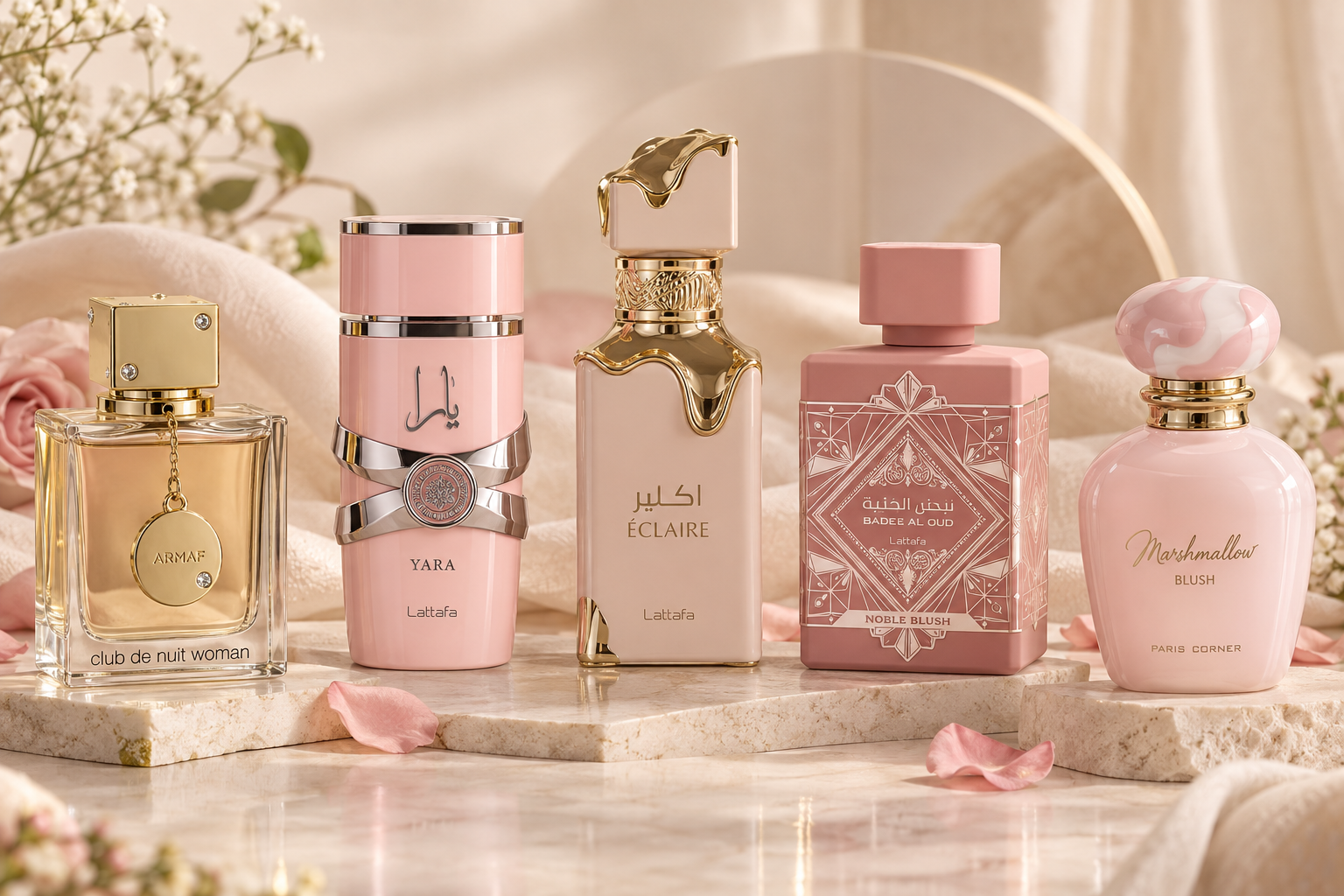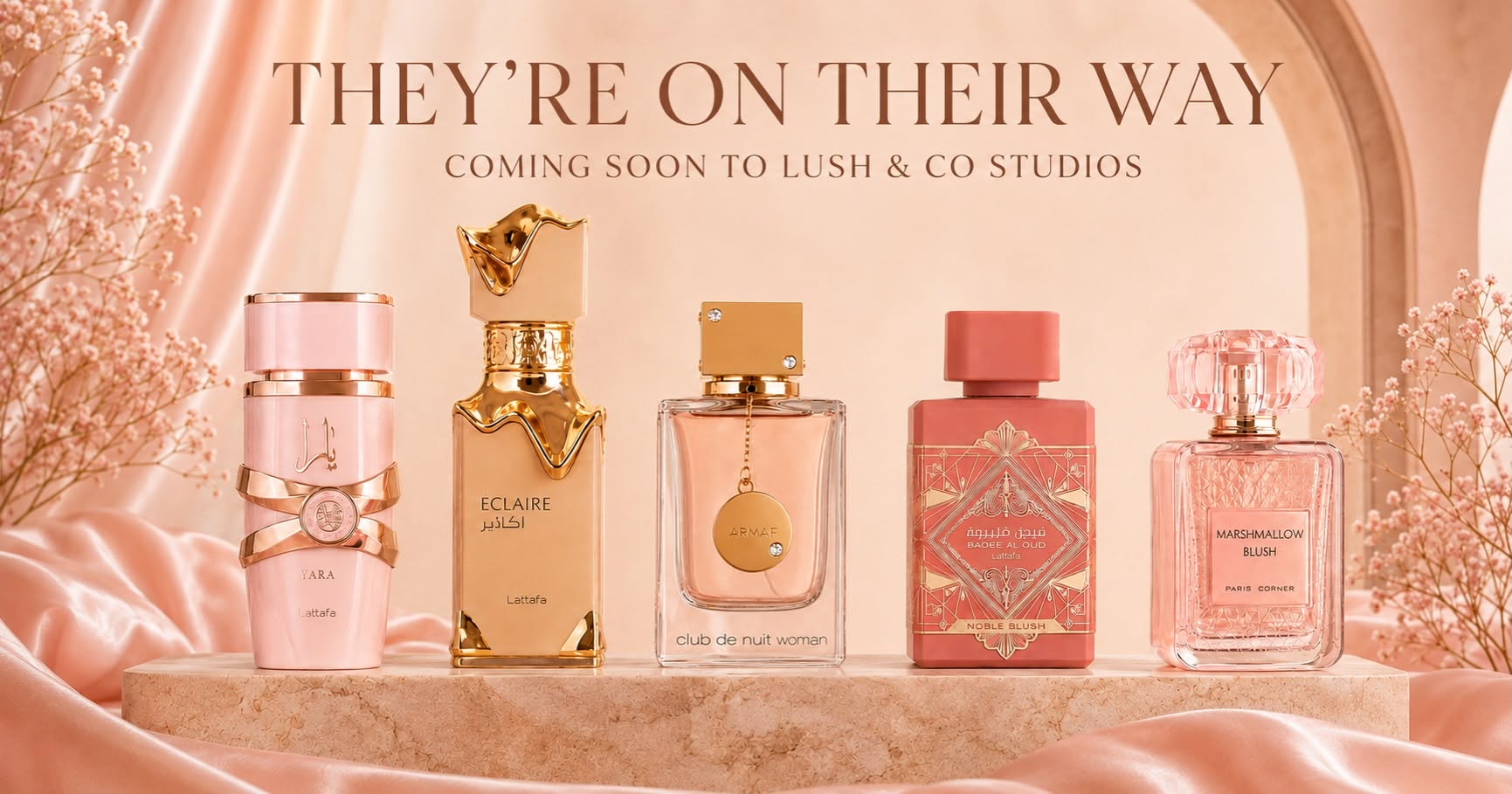
Something rather special is coming to Lush & Co Studios.
Over the coming weeks, we'll be introducing a carefully selected collection of Arabian perfumes and fragrances to the studio, bringing something a little different to our shelves and giving our clients the opportunity to discover a style of perfumery with a rich and fascinating heritage.
We aren't simply choosing a large catalogue and putting everything on display.
Instead, we're taking our time to hand-select a smaller collection of fragrances that we genuinely love — scents we'd be excited to wear ourselves, recommend to our clients and give as gifts.
Some will be warm and luxurious. Some sweet and inviting. Others fresh, floral, woody or beautifully intense.
And, of course, you'll be able to come into Lush, experience them properly and find the one that feels like you.
What Makes Arabian Perfume Different?
Fragrance has been an important part of life across the Middle East and Arabian Peninsula for centuries, with scent deeply connected to hospitality, personal grooming, celebration and tradition.
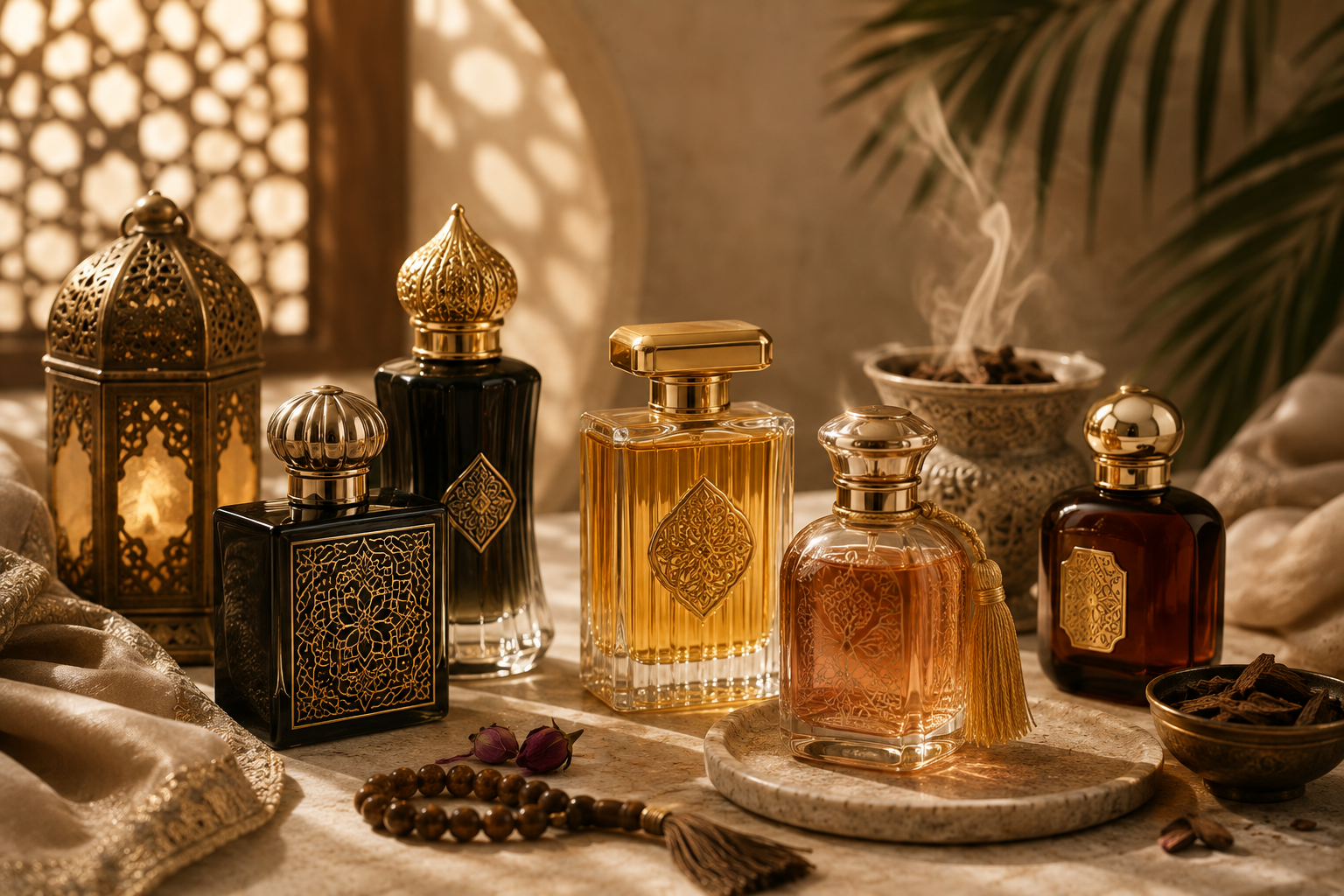
The region has particularly strong associations with ingredients such as oud, amber, musk, rose, sandalwood, saffron and aromatic spices.
Oud is perhaps the ingredient most closely associated with Arabian perfumery. Derived from the fragrant resinous heartwood produced by certain Aquilaria trees, its aroma can be incredibly complex — woody, warm, smoky, sweet and sometimes leathery.
It's also an ingredient that has increasingly found its way into mainstream Western perfumery.
Today you'll find oud-inspired fragrances from some of the world's biggest perfume houses, but its connection with Middle Eastern fragrance culture goes back much further.
A History Stretching Back Thousands of Years
The history of perfume isn't the story of one country or culture. Ancient fragrance traditions developed across regions including Mesopotamia, Egypt, Persia, India, Greece and Rome, with aromatic oils, resins, woods and flowers used for personal, ceremonial and medicinal purposes.
The Islamic Golden Age later played an important role in the development and documentation of perfume-making and distillation techniques.
One particularly important figure was the Persian polymath Ibn Sina, also known as Avicenna, whose work around distillation is often discussed in the history of extracting aromatic compounds and producing floral waters.
Arab and Persian scholars, traders and craftspeople existed at the crossroads of enormous trading networks, providing access to precious aromatic materials arriving from Africa, India and Southeast Asia.
Over centuries, these influences helped create an extraordinarily rich fragrance culture that continues today.
Oud, Bakhoor and Attar
Explore Arabian fragrance and you'll quickly encounter a few terms you may not see on the average perfume counter.
Oud is the intensely aromatic resinous wood mentioned earlier and is used in countless Middle Eastern fragrance compositions.
Bakhoor generally refers to scented wood chips or incense mixtures that are burned to perfume a room, clothing and surroundings. The fragrance released can create an instantly recognisable warm and welcoming atmosphere.
Then there's attar, traditionally referring to concentrated perfume oils. Rather than necessarily relying on the familiar alcohol-based spray format, perfume oils can be applied directly to the skin in small quantities.
These traditions are part of what makes exploring Arabian fragrance so interesting — it's an entire culture surrounding scent rather than simply another bottle of perfume.
Why Have Arabian Fragrances Become So Popular?
If you've been anywhere near fragrance TikTok, Instagram or YouTube recently, you've probably noticed just how much attention Middle Eastern perfume houses are receiving.
There's a good reason.
Many modern Arabian fragrances combine traditional Middle Eastern influences with contemporary perfume styles.
That means you can find everything from deep oud and amber compositions to gourmand vanilla fragrances, fresh citrus scents, florals, fruits, musk and sophisticated woody blends.
There are fragrances for people who want something bold and noticeable, but equally there are beautifully subtle options for those who prefer something softer.
Another attraction is the experience of discovering something different.
Instead of automatically reaching for the same familiar designer fragrance, people are becoming more adventurous with perfume and looking for scents with their own character.
Fragrance Is Personal
One thing we've learned while looking through the fragrances we'd like to bring to Lush is just how personal perfume really is.
A fragrance can smell completely different from one person to another.
Something you adore might not be your friend's favourite, while a bottle you would never have chosen from its description could become the fragrance you can't stop wearing once you've tried it.
That's why we don't want this simply to be an online product range.
We want you to be able to come into Lush and discover the fragrances for yourself.
Try them.
Give them a few minutes on your skin.
See how they develop.
And find the ones you keep going back to.
We're Hand-Selecting the Collection
We're currently working through the different options and choosing the fragrances we think deserve a place at Lush.
Rather than trying to stock hundreds of different bottles, our initial collection will be carefully curated.
We'll be looking for a mixture of styles so there's something for different tastes — from elegant everyday fragrances through to richer scents for evenings and special occasions.
We'll also be choosing fragrances that we feel offer something interesting compared with what you might normally find locally.
And as the collection grows, we'll listen to you.
If there are particular fragrance styles, notes or Arabian perfume houses you'd love us to explore, tell us.
For Her, For Him — or Simply for You
Although perfumes are traditionally divided into men's and women's categories, fragrance is becoming increasingly less restrictive.
Many Arabian fragrances are naturally unisex, particularly those built around oud, amber, musk, woods and spices.
Our approach will be simple:
If you love how it smells, wear it.
We'll help you explore the collection based more on the type of scent you enjoy than the label on the bottle.
They Make Beautiful Gifts Too
We're also excited about the gifting possibilities.
A beautiful fragrance makes a lovely birthday, anniversary, Christmas or Valentine's gift — particularly when it's something the recipient may not already have discovered themselves.
And for those impossible-to-buy-for people, there's always the option of letting them come in and choose their favourite.
Something New Is Coming to Lush
Beauty has always been about more than one particular treatment or product.
It's about those little things that make you feel good — freshly finished nails, glowing skin, an hour to yourself or that final spray of a fragrance you absolutely love before heading out the door.
That's why we think perfume feels perfectly at home at Lush & Co Studios.
We're currently smelling, testing and narrowing down our favourites, and we can't wait to show you what we've chosen.
Arabian fragrance is coming to Lush very soon.
Keep an eye on our Journal and social media over the coming weeks as we reveal the first fragrances joining the collection.
And when they arrive, come in and have a smell.
You might just discover your new signature scent.